How to Fill Up Your Freelance Client Pipeline in 2026
Learn how to track and manage your freelance client pipeline in 2026. Download the free Sales Pipeline Tracker to stay organized and grow revenue.


Heads up: Some of the links below are affiliate links, which means I may earn a small commission if you choose to use them — at no extra cost to you. I only recommend tools I personally use and trust.
After a month and a half of holiday travels, I'm finally home in Dubai! I’m locked and loaded, ready to crush 2026 with my freelance business.

Quick update: While I was traveling, my newsletter grew by over 500 readers. I read through every single welcome survey response, and 90% of you mentioned the same thing: you need help with finding clients.
You need help finding leads and turning them into paying clients.
So that's what I'm focusing on for this article and the next four. Every Friday, I'll publish a blog post laying out the exact system I use to keep my pipeline full and my calendar booked.
And today, I start with the foundation: sales tracking.
I’ll take you along as I’m filling up my personal client pipeline like crazy using my Network Harvesting Strategy. No platforms. No cold applying. Just reaching out to people who are already in my immediate and extended network.
The Problem Most Freelancers Have
Most freelancers miss out on so many opportunities they’ve come across because they don’t have a system in place to track who they meet and interact with on the internet.
- You meet someone at an event.
- You have a great conversation on a discovery call.
- Someone says "let me think about it and get back to you."
- A former client mentions they might have work coming up.
Then life happens. Client work piles up. You forget to follow up. They hire someone else.
Most freelancers are sitting on thousands of dollars in potential revenue that's slipping through the cracks simply because they don't have a system to track their pipeline.
It’s just like losing weight: If you don’t measure it, you can't manage it.
Why Your Freelance Client Pipeline Matters
"Pipeline management" sounds like corporate BS that doesn't apply to freelancers.
You're just one person trying to land enough work to pay the bills and maybe take a vacation without stress.
But the difference between freelancers making $3K/month and freelancers making $15K/month is pipeline.
Let me break down why freelance client pipeline management actually matters, especially if you want to scale past the "scrambling for clients" phase:
1. You can't rely on referrals forever
Referrals are great. I love them. But they're also unpredictable. Some months you get three. Some months you get zero.
A pipeline gives you control. You're always working on filling it, always nurturing relationships, always moving prospects forward. When a referral comes in? Awesome. But you're not desperate for it because you've got other irons in the fire.
2. Feast-or-famine cycles kill freelance businesses
You know the pattern: You're slammed with client work. Bills are paid, life is good. Then projects end. You scramble to find new clients. You take whatever comes your way, even if it's not ideal.
A well-managed pipeline smooths this out. While you're delivering for current clients, you're also having conversations with future clients. When one project wraps, another one is ready to start.
3. You make better decisions when you have options
When your pipeline is empty and someone offers you a $2K project that you know should be $5K, you take it. Because what choice do you have?
When your pipeline is full and that same person offers you $2K, you can say "my minimum for this type of work is $5K" and actually mean it. If they walk? Fine. You've got three other conversations happening.
A full pipeline is first of all being able to say no to the wrong clients and yes to the right ones.
4. It forces you to think like a business, not a freelancer
This is where how to run your business actually starts to click. When you track your pipeline, you start asking better questions:
- "Which outreach channels are converting best?"
- "How long does it take from first contact to signed contract?"
- "What's my average deal size?"
- "Where are prospects dropping off?"
These insights can help you double down on what's working and cut what's not. That's how you scale a freelance marketing business past the point where you're trading hours for dollars.
5. It keeps you proactive instead of reactive
Without a pipeline, you're constantly reacting. A client cancels? Panic mode. A project ends early? Scramble time.
With a pipeline, you're proactive. You're building a future where you're never desperate.
Client Pipeline for Freelancers: Why Tracking Changes Everything
When you start tracking your leads properly, three things happen:
1. You stop losing opportunities
Every conversation gets logged. Every follow-up gets scheduled. Nothing falls through the cracks because everything lives in one place.
2. You see patterns in your pipeline
You start noticing: "I've reached out to 10 cold prospects this month and only got 1 response. But I've contacted 5 former clients and 3 are interested." That data tells you where to focus your energy.
3. You build a system, not a hustle
Instead of waking up Monday morning wondering "who should I reach out to today?", you open your tracker and see exactly who needs a follow-up, who's ready for a proposal, and who to nudge forward.
The freelancers making $10K+ per month aren't smarter than you. They just have better systems.
Understanding Your Pipeline Metrics: What to Track
Now what the hell do you actually track?
Most freelancers either track nothing or track everything (which is just as useless because you drown in data).
These are the core metrics I track in my pipeline, and the ones that have directly contributed to my $316K year:
1. Total Active Prospects
How many conversations are currently live in your pipeline? Not total contacts. Not LinkedIn connections. Actual people you're actively talking to about potential work.
This number should never be zero. If it is, you're already behind. I try to keep mine between 10-20 at any given time.
2. Prospects by Stage
Break your pipeline into stages:
- Initial contact: You've reached out, they've responded
- Discovery call scheduled: They've agreed to talk
- Proposal sent: You've sent pricing/scope
- Negotiation: They're interested but working through details
- Closed-won: They signed
- Closed-lost: They went another direction
If you've got 15 prospects but all of them are stuck at "Initial contact" and none are moving to "Discovery call," you've got a conversion problem. If you're getting lots of discovery calls but no proposals sent, you've got a qualification problem.
The data tells you where your process is breaking.
3. Average Time to Close
How long does it take from first contact to signed contract?
In my business, it's typically 2-4 weeks for warm leads and 4-8 weeks for cold outreach. Knowing this helps me forecast revenue and plan my outreach timing.
If you need work in 30 days, you better be reaching out today. Not next week.
4. Conversion Rate by Source
Where are your best clients coming from?
- Former clients: 60% conversion rate for me
- Referrals: 40%
- LinkedIn cold outreach: 8%
- Twitter/X DMs: 12%
- Networking events: 15%
This tells me I should spend more time nurturing past clients and getting referrals than I should grinding out cold LinkedIn messages.
5. Pipeline value
Add up the potential revenue of all your active deals. If you close 30% of them (a reasonable benchmark), what's that worth?
Example: If I have $80K in potential pipeline value and I historically close 30%, I'm looking at about $24K in upcoming revenue. If my monthly expenses are $8K, I know I need to either close faster or add more to the pipeline.
This metric keeps you from getting complacent. A full pipeline feels good, but if it's all $1K deals and you need $10K/month to survive, you've got a problem.
6. Last contact date
When did you last touch base with each prospect?
If it's been more than 7 days since your last contact and they haven't explicitly said "not interested," you need to follow up.
I set reminders for every prospect: 3 days after proposal sent, 5 days after discovery call, 7 days after initial outreach. Automate the reminders so you don't have to remember.
7. Reason for loss (when deals die)
When a prospect says no or ghosts, track why:
- Budget
- Timing
- Went with someone else
- Not a good fit
- No response
Over time, you'll see patterns. If you're consistently losing deals to budget, you might be targeting companies that are too small. If you're losing to "went with someone else," you might have a positioning or pricing problem.
My entire tracking system is a Google Sheet with these columns:
- Name
- Company
- Source
- Stage
- Last Contact
- Next Action
- Deal Value
- Notes
That's it. Simple, fast, effective.
Your goal is to have enough information to make smart decisions about where to spend your time and energy.
Because time is your only non-renewable resource as a freelancer. Freelance client pipeline management is really just about not wasting it on the wrong prospects.
My Gift to You
I'm giving you the exact Sales Pipeline Tracker I use to manage every single prospect, lead, and client in my business.
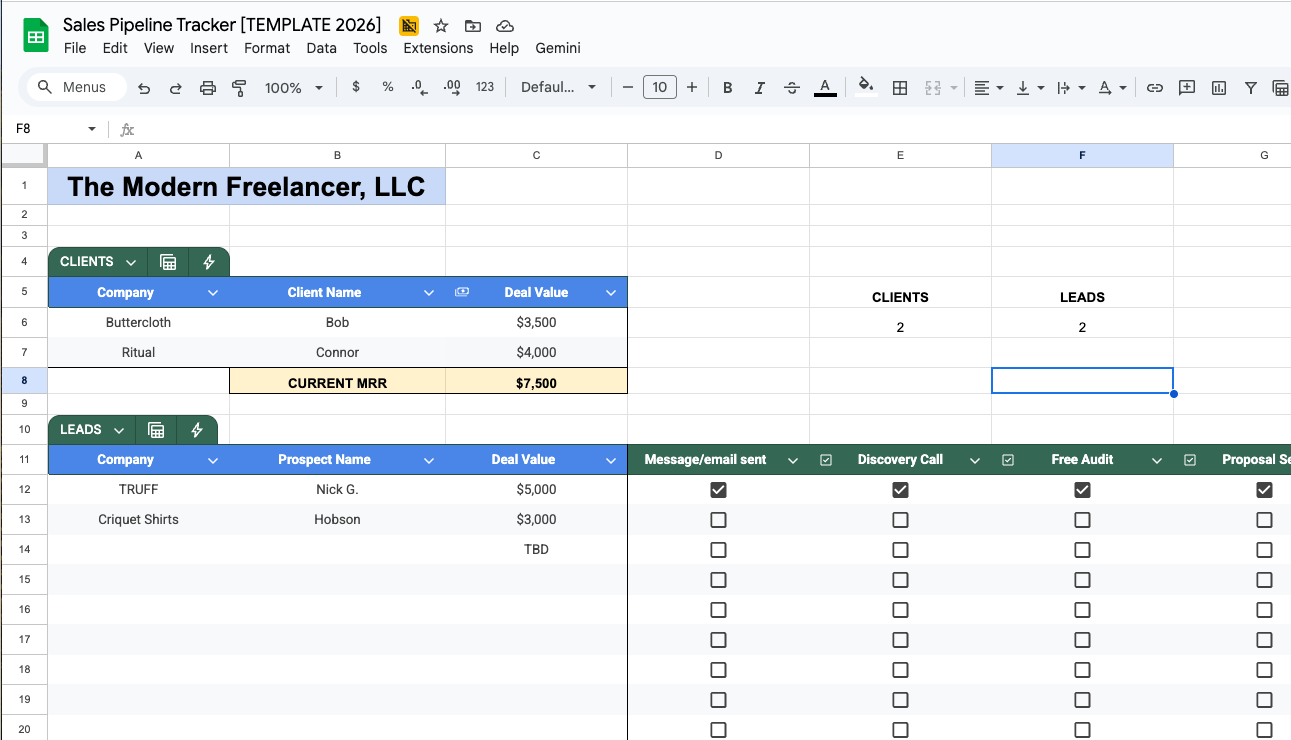
This isn't some complicated CRM or fancy software. It's a simple spreadsheet that tracks everything you need: name, their tier (prospect/lead/client), where you contacted them, last contact date, next follow-up, and potential deal value.
I've used this tracker to generate over $316K in freelance revenue in 2025. It's helped me connect with more clients than I could handle and allowed me to be able to say no to the wrong opportunities. Most importantly, this pipeline will keep you organized when you’re juggling 5+ conversations at once.
You can grab it for free here: https://themodernfreelancer.gumroad.com/l/sales-tracker
Download it now. We're going to use it over the next 5 weeks.
The Old Freelancer Way vs. The Modern Freelancer Way
The old freelancer way:
- Keep track of leads in your head or scattered across texts and emails
- Forget to follow up with warm prospects because you're busy with client work
- Lose opportunities because you don't remember where conversations stand
The modern freelancer way:
- Track every prospect, conversation, and deal in one central place
- Set follow-up reminders so nothing slips through the cracks
- Use data to focus your outreach on what's actually working
Your Action Step
This week:
- Download my free Sales Pipeline Tracker (the exact one I use): https://themodernfreelancer.gumroad.com/l/sales-tracker
- Make a copy and spend 15 minutes filling in the basics: existing clients, past clients, and anyone you've talked to recently about potential work
- Start logging every new conversation from this point forward, even if it's just a name and a note
That's it. Just get it started.
Next Friday is when the real fun starts. I'm going to show you exactly how to put this tracker to WORK. I'll walk you through how to fill it with 20+ high-quality prospects and teach you my system for turning those names into paying clients.
Over the next 5 weeks, I'm helping you build the pipeline that's going to make 2026 your best year yet.
--
I write a free newsletter where I send out actionable freelance marketing tips. If you want to keep an edge and stand out in the increasingly competitive freelance landscape, consider signing up.
Contents