Collective Review 2026: My Honest Experience as a Freelancer
The Modern Freelancer's honest review of Collective for freelancer taxes, bookkeeping, and S Corp setup.


Heads up: Some of the links below are affiliate links, which means I may earn a small commission if you choose to use them — at no extra cost to you. I only recommend tools I personally use and trust.
Let's be real: accounting is every freelancer's nightmare.
You didn't start freelancing because you love bookkeeping and figuring out quarterly estimates. You started because you wanted freedom, creative control, and the ability to build something on your own terms. But then reality hits. You need to figure out self-employment taxes, estimated payments, deductions, bookkeeping, and about a hundred other things nobody warned you about.
So you ask around. Your freelancer friends don't really know either. Someone says "just get a CPA," but when you ask for a recommendation, nobody has one they're genuinely excited about. You try Googling it, and the IRS website reads like it was written to confuse you on purpose.
For years, I bounced between bad accountants, messy QuickBooks files, and the constant anxiety of wondering if I was doing something wrong. Then I was recommended Collective.
I've been using it for over three years now, and it's the first time I've actually felt like my finances are handled. Not perfect, not magic, but genuinely handled. Here's my honest review.
What Is Collective? (And Who Is It Built For)
Collective is a financial solution built specifically for self-employed entrepreneurs and freelancers. They handle the stuff most of us dread: S Corp formation, bookkeeping, payroll, tax filing, and ongoing financial advisory.
Think of it as an entire finance department for your freelance business. Instead of hiring a CPA, a bookkeeper, and figuring out payroll software separately, the Collective company bundles it all into one membership.
Collective started as a startup focused on solving a specific problem: freelancers and solopreneurs were overpaying on taxes and spending way too much time on financial admin. Their solution was to make S Corp election, which can save freelancers thousands in self-employment taxes, accessible and easy. Today, Collective finance services cover everything from business formation to year-end tax filing.
Collective is designed for freelancers making $80K or more per year. If you're at that income level and you're still operating as a sole proprietor, you're almost certainly leaving money on the table. More on that in a minute.
You can check out Collective here.
Why I Left My CPA for Collective
Before Collective, I was working with a CPA at a nationally recognized firm. I was paying $6,500 per year. That sounds like it should buy you a lot of service, right?
Here's what I actually got: they filed my taxes once a year. That's it. No bookkeeping. No quarterly support. No proactive tax strategy. I was still doing everything myself in QuickBooks, spending hours every month trying to reconcile transactions and figure out which expenses were deductible.
The breaking point came when the IRS sent me a correction check. My CPA's firm had messed up my Q3 estimated payment so badly that the IRS had to step in and fix it. For context, refunds for self-employed individuals are unusual and usually mean something was filed incorrectly. I was paying $6,500 a year for someone to make mistakes I could have made for free.
I started researching alternatives. I spent about six weeks reading reviews, talking to other freelancers, and having calls with different services. Collective kept coming up. What caught my attention was that they didn't just offer tax filing. They offered to handle the entire financial backend of my freelance business: bookkeeping, payroll, S Corp setup, quarterly estimates, and year-round advisor access.
I signed up and haven't looked back.
Collective S Corp Setup: How I Saved $13,800 in Year One
This is the section that matters most if you're trying to decide whether Collective is worth it.
When you're a sole proprietor (which is how most freelancers start), you pay self-employment tax of 15.3% on your entire net business income. That's Social Security and Medicare taxes, and it adds up fast.
With an S Corp structure, you split your income into two buckets: a reasonable salary and distributions. You only pay self-employment tax on the salary portion. The distributions are not subject to that 15.3% tax.
Here's what that looks like in practice:
The "reasonable salary" part is important. The IRS requires that your salary is reasonable for the work you do. You can't pay yourself $20K and take $130K in distributions. Collective's tax advisors helped me determine the right salary for my situation, which kept everything within IRS guidelines.
In my first full year with Collective, I saved $13,800 in self-employment taxes. That's nearly a 4x return on my annual membership fee.
The best part? Collective handled the entire S Corp formation process. I filled out some basic information about my business, and their team filed all the paperwork with the IRS. No lawyers, no confusion, no stress. Within a few weeks, my business was officially structured as an S Corp.
See how much you could save with Collective.
Collective Accounting and Bookkeeping: What the Monthly Workflow Looks Like
Before Collective, I was spending 4 to 6 hours every month trying to reconcile my accounts in QuickBooks. I'd miss transactions, miscategorize expenses, and create problems that would haunt me at tax time. Bookkeeping was easily my least favorite part of running a business.
Now I spend about 15 minutes per month. Here's my actual workflow:
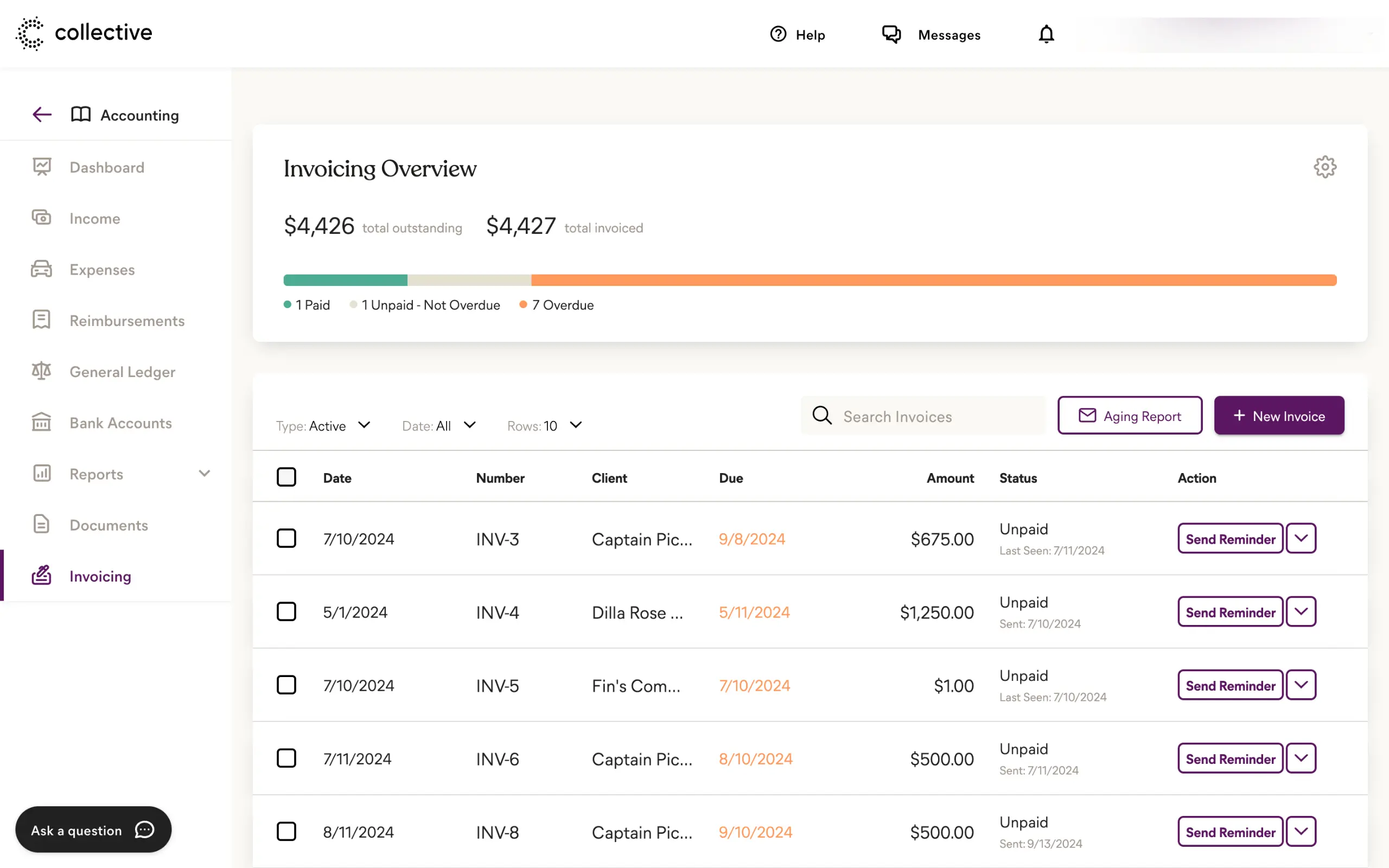
Around the first of each month, I log into the Collective platform and upload my bank and credit card statements. If anything syncs automatically, even better. Then I fill out a quick reimbursement form for any business expenses I paid with personal funds (like a client dinner or a coworking day pass).
That's it. That's all I do.
My dedicated bookkeeper at Collective takes it from there. They categorize every transaction, reconcile my accounts, and send me a clean financial report by the end of the month. If there's something unusual or a transaction they're unsure about, they email me to clarify.
The difference between doing Collective accounting yourself and having a dedicated bookkeeper who specializes in freelancer finances is massive. They know what's deductible, how to categorize things correctly, and what to flag. I'm not guessing anymore.
During tax season, there's no panic. My bookkeeper and CPA have been tracking everything all year. Quarterly estimates are calculated for me. Filing becomes a review process instead of a scramble.
Collective Pricing: Is It Worth the Monthly Cost?
Collective pricing breaks down like this:
- Annual plan: $297/month ($3,564/year)
- Monthly plan: $349/month ($4,188/year)
Here's what's included in that membership:
- S Corp formation and election
- Full-service monthly bookkeeping
- Quarterly tax estimates (calculated for you)
- Business and personal tax filing
- Payroll through Gusto (subscription included)
- QuickBooks (subscription included)
- Year-round access to a dedicated tax advisor
To put that in perspective, here's how Collective compares to the alternatives:
The ROI math is simple: I pay $3,564 per year for Collective. I save $13,800 per year in self-employment taxes. That's a net positive of $10,236 before you even factor in the time I'm saving on bookkeeping and the stress I've eliminated.
Now, the honest caveat: if you're making under $60,000 to $80,000 per year, the tax savings from an S Corp election may not justify the membership cost. Collective is upfront about this, and I respect that. This isn't a product that makes sense for everyone.
See if Collective is right for you.
Collective Review: The Honest Pros and Cons After 3+ Years
I've been a Collective member for over three years. Here's what I genuinely think after using the service through multiple tax seasons, business changes, and quarterly cycles.
What I love:
The S Corp tax savings paid for my membership many times over. This is the headline benefit and it's real. $13,800 saved in year one, and the savings compound every year I stay structured as an S Corp.
Bookkeeping went from my biggest headache to a 15-minute monthly task. I can't overstate how much mental energy this freed up. I actually enjoy reviewing my financials now because someone competent is handling the work.
Year-round advisor access changed how I think about my business finances. I can email my advisor in July about a big purchase decision and get actual guidance, not just "we'll figure it out during tax season."
All the software is included. Gusto for payroll, QuickBooks for accounting. Those subscriptions would cost me roughly $85 per month on their own. They're bundled into the Collective membership.
What could be better:
The monthly cost feels steep at first. $297 to $349 per month is a real line item. It took me a couple of months to stop wincing at the charge, and it wasn't until I saw my first quarterly tax estimate (significantly lower than before) that the value really clicked.
You still need to stay organized. Collective doesn't magically track your receipts for you. If you expense a client dinner, you need to note it. If you buy equipment, you need to upload the receipt. They handle the heavy lifting, but you need to do the basics.
Response times can vary. Most of the time, I get answers within 24 hours. During peak tax season, it can take a bit longer. Not a dealbreaker, but worth knowing.
The platform dashboard has a learning curve. The first month, I spent some time figuring out where things were and how to navigate the interface. It's intuitive once you know it, but there's an adjustment period.
S Corp structure isn't for everyone. If you're making under $80K per year, the compliance requirements and costs may outweigh the tax savings. This is a legitimate limitation, not a flaw.
Is Collective Legit?
I get why people search this. Handing over your tax situation to an online platform feels risky when you're used to sitting across from someone at a desk.
Collective is a real company with real employees, real CPAs, and real bookkeepers. They've been around since 2020, they're based in San Francisco, and they serve thousands of freelancers and solopreneurs. I've personally used them for over three years, through multiple tax seasons, and they've handled everything correctly.
Are they perfect? No. But they're significantly better than any CPA I've worked with, and they're designed specifically for the way freelancers work.
See how much you could save with Collective.
Collective vs Bench, QuickBooks, and a Traditional CPA
Before switching to Collective, I also looked at Bench and considered sticking with the DIY QuickBooks approach. Here's the quick comparison:
Bench was solid for basic bookkeeping but didn't offer S Corp formation, tax strategy, or CPA access. I would have still needed a separate accountant for tax filing and planning. And as of late 2024, Bench shut down, which left a lot of freelancers scrambling.
Traditional CPAs offer more personalized service, but in my experience, they charge significantly more and still expect you to handle your own bookkeeping. Most of them aren't specialized in the unique challenges freelancers face. And good luck getting a response in June.
DIY with QuickBooks and TurboTax is definitely the cheapest option. But only if you don't value your time. Between learning the software, categorizing transactions, researching deductions, and hoping you're doing everything correctly, I was spending 40+ hours per year on financial tasks I'm not qualified to do.
Collective hits the sweet spot: professional expertise, comprehensive services, and a price point that makes sense when you factor in the tax savings.
For a detailed comparison, read our full Collective vs QuickBooks breakdown. You can also see how Collective stacks up against Bench in our Collective vs Bench comparison.
Who Should Use Collective? (And Who Should Wait)
After three years of using Collective, here's my honest recommendation based on income level:
If you're making $100K+ per year as a freelancer: Collective is a no-brainer. The S Corp tax savings alone will likely cover your membership cost several times over. You're leaving thousands on the table every year you wait.
If you're making $60K to $80K: It's worth a conversation. Book a free consultation with Collective and have them run your specific numbers. For some freelancers at this level, the savings justify the cost. For others, it might make more sense to wait until your income grows.
If you're making under $60K: Hold off for now. The S Corp compliance requirements and monthly membership cost probably don't make sense yet. Focus on growing your freelance income, and come back to Collective when you're ready.
Regardless of where you fall, understanding how S Corp structure works is worth your time. Even if you're not ready for Collective today, knowing how much you could save in the future gives you a clear target to work toward.
Try Collective
I saved $13,800 in self-employment taxes in my first year with Collective. My bookkeeping went from a 6-hour monthly headache to 15 minutes. And for the first time in my freelance career, I actually feel confident that my finances are handled correctly.
If you're a freelancer who's tired of overpaying on taxes and wasting time on bookkeeping, Collective is worth looking into.
See how much you could save with Collective.
Frequently Asked Questions
How much does Collective cost per month?
Collective costs $297 per month on the annual plan ($3,564/year) or $349 per month if you pay monthly ($4,188/year). This includes S Corp formation, full-service bookkeeping, tax filing, Gusto payroll, QuickBooks, and year-round advisor access.
Is Collective worth it for freelancers?
If you're making $80K or more per year, yes. The S Corp tax savings alone typically cover the membership cost, and everything else (bookkeeping, advisor access, payroll) is essentially a bonus. If you're under $80K, run the numbers with their team first.
How much can you save with Collective's S Corp election?
Collective claims members save an average of $10,000 per year. In my experience, I saved $13,800 in my first year. The exact amount depends on your income level and how your salary vs. distributions are structured.
Does Collective handle bookkeeping?
Yes. Full-service monthly bookkeeping is included in every Collective membership. A dedicated bookkeeper categorizes your transactions, reconciles your accounts, and delivers a clean financial report each month.
Is Collective legit?
Yes. Collective (formerly Hyke) has been operating since 2020, is based in San Francisco, and serves thousands of self-employed professionals. I've personally used them for over three years through multiple tax seasons. They employ real CPAs and bookkeepers who specialize in freelancer finances.
What's included in a Collective membership?
Every membership includes: S Corp formation and election, full-service bookkeeping, quarterly tax estimates, business and personal tax filing, payroll through Gusto (subscription included), QuickBooks (subscription included), and year-round access to a dedicated tax advisor.
Contents